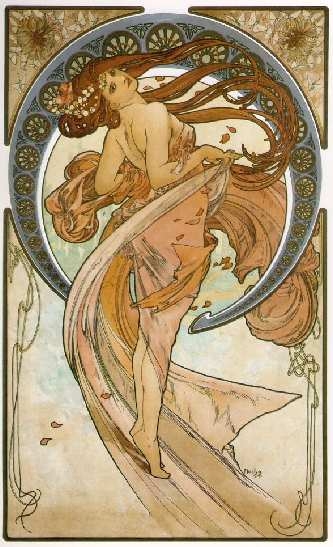
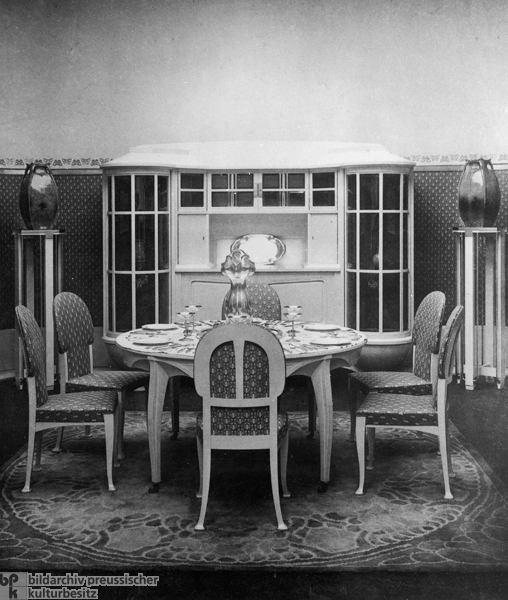
The origins of Art Nouveau are found in the resistance of William Morris to the cluttered compositions and the revival tendencies of the Victorian era and his theoretical approaches that helped initiate the Arts and crafts movement.
The movement was influenced by the Symbolists most obviously in their shared preference for exotic detail, as well as by Celtic and Japanese art. Art Nouveau flourished in Britain with its progressive Arts and Crafts movement, but was highly successful all around the world.
At the end of the nineteenth century, Art Nouveau transformed neighborhoods and whole towns around the world into remarkable examples of the contemporary, vital art of the age. Even though its style was at its zenith for just a decade, Art Nouveau permeated a wide range of the arts. Jewelery, book design, glasswork, and architecture all bore the imprint of a style that was informed by High Victorian design and craftwork, including textiles and wrought iron. Even Japanese wood-block prints inspired the development of Art Nouveau, as did the artistic traditions of the local cultures in which the genre took root.
The leading exponents included the illustrators Aubrey Beardsley and Walter Crane in England; the architects Henry van de Velde and Victor Horta in Belgium; the jewelery designer René Lalique in France; the painter Gustav Klimt in Austria; the architect Antonio Gaudí in Spain; and the glassware designer Louis C. Tiffany and the architect Louis Sullivan in the United States. Its most common themes were symbolic and frequently erotic and the movement, despite not lasting beyond 1914 was important in terms of the development of abstract art.

Furthur information:
A really informative exhibit with audio to take you through the Art Nouveau period:
http://www.nga.gov/feature/nouveau/exhibit_audio.shtm
http://artnouveau.pagesperso-orange.fr/en/index.htm
A highly functional flash site displaying the work of Klimt:
http://www.iklimt.com/